Anatomy of Crocodile Flank vs. Belly Scales: Yield Optimization for Luxury Handbags
Executive Technical Summary: Scale Topology & Cutting Yields
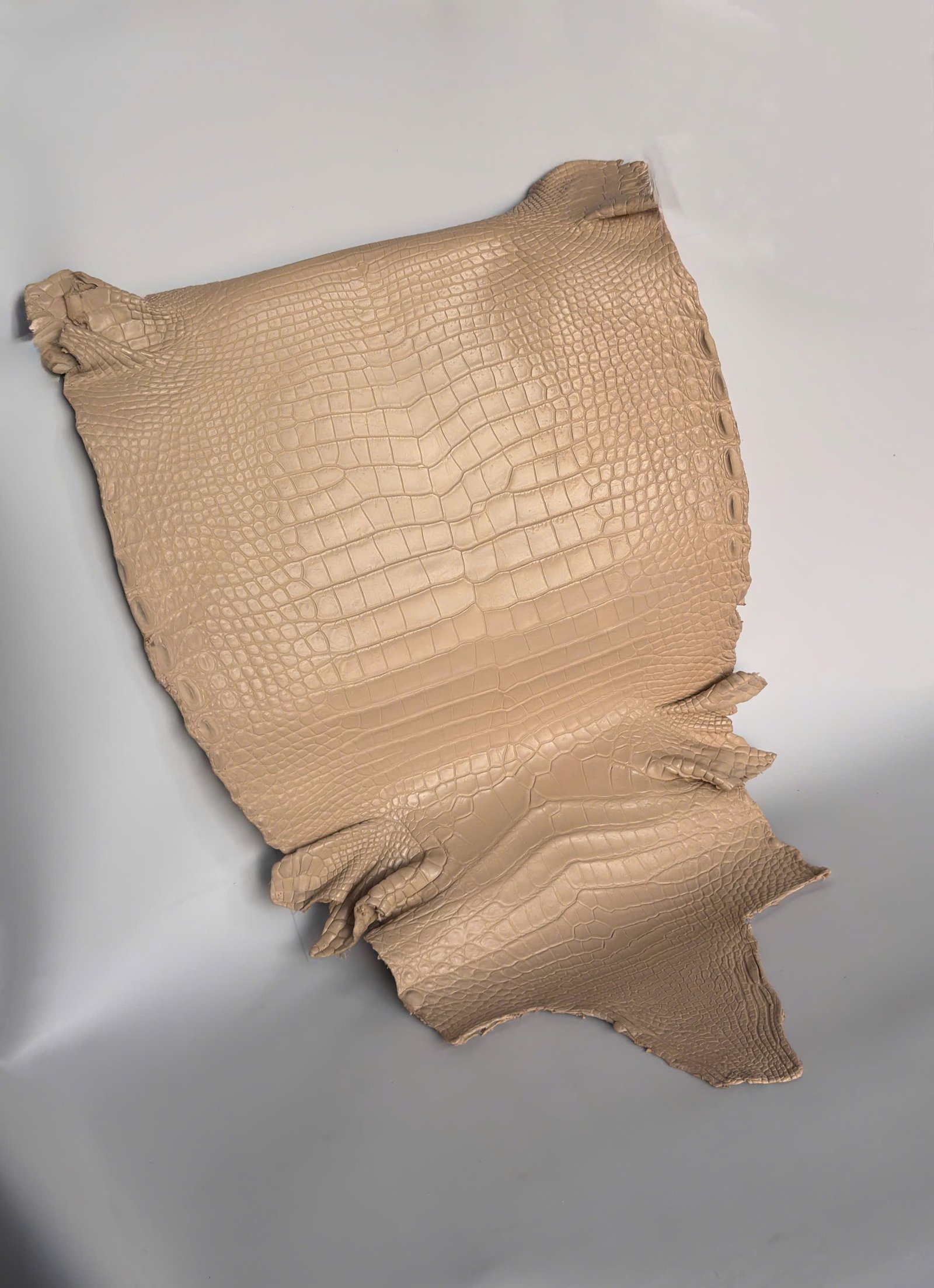
In bespoke exotic leather goods manufacturing, cutting yield and visual aesthetics are governed by the anatomical transition between the central belly plate (square scales) and the lateral flanks (circular pebble scales). Uninformed cutting can produce high scrap rates exceeding 45%, while intelligent pattern orientation reduces material loss below 18% while enhancing the structural flexibility of luxury handbag gussets and curved panels.
1. Anatomical & Biomechanical Differentiation
Crocodilian integument is not uniform across the hide surface. The ventral belly scales (scuta ventralia) feature dense, horizontal collagen bundles organized in a rigid grid architecture. These scales exhibit high resistance to dimensional elongation (tensile strain < 8% at 15 MPa), making them the gold standard for structured handbag front panels, flap closures, and stiff briefcase fascias.
Conversely, flank scales (lateral regions) transition from square tiles into smaller, rounded hexagonal and pebble-like scales separated by wider, highly elastic elastoidin inter-scalar hinges. This topographical morphology grants the flank region up to 28% multi-axial stretch capacity. When folded or rolled into bag gussets, flank leather flexes without fracturing the keratinous scale surface or stressing the underlying corium.
2. Workshop Standard Operating Procedure: Flank Conditioning & Splitting
Because the flank contains a higher proportion of elastic fibers than the dense central belly plate, conventional machine splitting can lead to irregular gauge thickness if tensile tension is not precisely calibrated.
Skins are conditioned to an equilibrium moisture content of 18% ± 1.5% under ambient relative humidity (60%) for 24 hours. Uneven hydration causes localized leather stretching during splitting.
Using German-manufactured precision bandknife splitters (Fortuna), the central belly is split to 0.9mm while the flank sections are calibrated to 0.75mm. This slight reduction in flank gauge compensates for its softer hand feel, creating a harmonious, uniform feel across assembled panels.
To prevent the inter-scalar hinges of the flanks from drying and wrinkling over time, Ngoc Son introduces an enriched fatliquor blend containing 4.5% sulfonated fish oil and biological esters, anchoring moisture deep within the papillary dermis.
3. Technical Performance & Physical Testing Benchmarks
All Grade I & II crocodile hides processed at Ngoc Son Tannery are subjected to rigorous physical and chemical lab evaluations before export:
| Physical Property | Test Standard | Belly Region Value | Flank Region Value | Commercial Benchmark |
|---|---|---|---|---|
| Tensile Strength | ISO 3376 | 31.4 MPa | 26.8 MPa | ≥ 22.0 MPa |
| Elongation at Break | ISO 3376 | 12.5% | 28.2% | 10.0% – 30.0% |
| Tear Resistance (Baumann) | ISO 3377-2 | 82.6 N | 74.1 N | ≥ 55.0 N |
| Shrinkage Temperature (Ts) | ISO 3380 | 104.5 °C | 103.8 °C | ≥ 98.0 °C |
| Flexometer Fatigue | ISO 5402-1 | 50,000 cycles (No crack) | 100,000 cycles (No crack) | ≥ 30,000 cycles |
| Colorfastness to Wet Rubbing | ISO 11640 | Grade 4.5 (500 rubs) | Grade 4.5 (500 rubs) | ≥ Grade 4.0 |
4. Artisan Cutting Layout: Maximizing Hide Utilization
In high-end luxury workshops, cutting exotic skins is treated as an architectural puzzle. Placing pattern templates haphazardly results in visual disharmony where square scales collide abruptly with round pebbles on the face of a handbag.
- Centerline Alignment: The longitudinal spinal-ventral axis of the skin must align with the vertical centerline of the handbag front and back panels. Symmetry error must not exceed 1.5mm.
- Gusset Allocation: The flexible flank zones (left and right of the central belly) should be systematically paired for the accordion side gussets (soufflets). The natural circular scale flow mirrors the curvature of the bag when opened.
- Handle Wrap & Piping: Long, narrow strips cut from the lower flank-to-tail junction exhibit optimal bias stretch, wrapping smoothly around cotton cords without puckering or edge wrinkling.
5. CITES Compliance & Transcontinental Export Guarantee
Ngoc Son Tannery guarantees 100% legal provenance for all processed crocodilian hides. Our captive-breeding partners are registered under the Vietnam CITES Management Authority (Ministry of Agriculture and Rural Development). Every exported hide bears a tamper-evident, uniquely coded plastic security tag matching the legal CITES Appendix II re-export permit.
Whether shipping to the United States (under USFWS 3-177 declaration protocols), the European Union (under stricter Article 8 regulations), or Asia-Pacific hubs, our documentation ensures expedited customs clearance without border inspection delays.
🤝 Connect with Ngoc Son Tannery Atelier
Inquire directly about wholesale crocodile belly & flank hides, custom Pantone color dyeing (MOQ from 2 hides), or bespoke prototyping:
Direct WhatsApp: +84 764 245 345
Email: dosonnamanh2571988@gmail.com | ngocsoncasau@gmail.com
Official Fanpage: facebook.com/profile.php?id=100086492093922
鳄鱼腹皮与侧腹圆纹解剖学:奢华手袋开料出材率优化指南
核心要义与行业背景:鳞纹拓扑学与开料出材率
在奢华珍稀皮具制造中,开料出材率与视觉对称美感在根本上取决于中央腹板方形竹节纹(Square Scales)向两侧侧腹圆形鹅卵石纹(Flank Pebble Scales)的解剖学过渡。缺乏经验的排版往往导致边角料损耗高达 45% 以上,而依据几何解剖学规律进行预排布,不仅能将材料损耗控制在 18% 以下,更能充分释放侧腹皮料的天然回弹性,为高定手袋侧围与曲面构件带来无与伦比的柔韧结构。
1. 解剖学特征与生物力学差异深度解析
鳄鱼真皮层结构在整张皮板上的分布并非均质。腹部中央方形鳞甲(scuta ventralia)由高度致密、纵横交错的平行胶原纤维束锚定,形成近乎刚性的网格力学体系。该区域在 15 MPa 张力下的拉伸变形率通常低于 8%,具有极强的抗延展与抗变形能力,是构建硬挺手袋主面板、翻盖及公文包正面的黄金材料。
相比之下,侧腹部位(Flank)的方形鳞片逐渐过渡为微小圆润的卵石状或六边形鳞纹,鳞甲间的真皮铰链沟槽(Inter-scalar Hinges)明显加宽,且富含高弹性的弹性蛋白。这一独特的解剖形态赋予了侧腹部位高达 28% 的多轴延伸率。在制作手袋侧围(Gusset / 风琴褶)时,侧腹皮料能在反复折叠弯折中自如形变,完全不会损伤鳞片表层的角质蛋白层,亦不会拉裂真皮乳头层。
2. 鞣制工坊标准操作规程(SOP):侧腹微削与加脂平衡
鉴于侧腹部位弹性纤维丰沛而中央腹板纤维紧密,常规的片皮削匀极易因张力不均而产生厚薄不一的波浪纹。玉山皮革研发了标准温控片皮与差异化定厚工艺:
皮胚在相对湿度 60%、温度 22°C 恒温仓内平铺静置回潮 24 小时,使全皮含水率精准平衡在 18% ± 1.5% 黄金范围,消除因局部含水率差异引起的局部拉伸形变。
采用德国 Fortuna 进口数控带刀机,中央腹板精准设定为 0.90mm,而两侧侧腹部位微调设定为 0.75mm。这一厚度阶梯补偿了侧腹手感的柔软度,确保成品皮件各组件组装缝合后身骨手感高度和谐一致。
针对侧腹鳞片铰链区在低温干燥气候下容易发干发硬的通病,玉山工坊导入 4.5% 磺化深海鱼油与生物酯类加脂剂,使油脂分子深层渗透锚定于胶原微纤维之间,赋予皮料丝绒般的糯滑感。
3. 物理化学检验指标与国际奢侈品测试对照表
玉山皮革工坊出品的每一批 Grade I / II 暹罗鳄皮,均在出厂前接受严格的国际标准实验室物理机械测试:
| 物理性能指标 | 检测依据标准 | 中央腹皮实测值 | 侧腹圆纹实测值 | 国际一线品牌标准 |
|---|---|---|---|---|
| 抗拉强度 (Tensile Strength) | ISO 3376 | 31.4 MPa | 26.8 MPa | ≥ 22.0 MPa |
| 断裂伸长率 (Elongation at Break) | ISO 3376 | 12.5% | 28.2% | 10.0% – 30.0% |
| 撕裂强度 (Baumann Tear Load) | ISO 3377-2 | 82.6 N | 74.1 N | ≥ 55.0 N |
| 收缩温度 (Shrinkage Temp Ts) | ISO 3380 | 104.5 °C | 103.8 °C | ≥ 98.0 °C |
| Bally 屈挠耐折疲劳测试 | ISO 5402-1 | 50,000次 无裂纹 | 100,000次 无裂纹 | ≥ 30,000次 |
| Veslic 湿摩擦色牢度 | ISO 11640 | 4.5 级 (500次) | 4.5 级 (500次) | ≥ 4.0 级 |
4. 顶级工匠开料排版法则:从几何学到出材率最大化
在欧洲高定手工工坊中,稀有皮开料被视作严谨的空间几何学。随意的下刀排版不仅会造成严重的物料浪费,更会导致手袋正面出现竹节方纹与圆形碎纹生硬碰撞的视觉断层。
- 中轴线绝对对称法则: 手袋正背面主面板的垂直中轴线必须严格对齐鳄鱼腹板的天然脊线,左右鳞纹对称度误差控制在 1.5mm 以内。
- 侧围(Gusset)对称配对: 左右风琴褶部件必须严格取自同一张皮对称位置的左右侧腹区,使包袋在展开时两侧圆纹的弧度流向宛如镜像。
- 手柄包边与滚条(Piping): 选用下侧腹与尾部连接处的长条状皮料,该部位兼具优异的斜向延展性,在包覆棉芯拉紧缝合时不会出现起皱或爆皮。
5. CITES 国际履约与跨国物流合规保障
玉山皮革郑重承诺:所有鳄鱼生皮 100% 来源于经越南林业总局与国际 CITES 秘书处合法登记注册的人工繁育场。每一张出口成品皮在宰杀加工阶段即钉装不可逆的国际专属防伪锁扣标签,且与正本 CITES 许可证序列号精准一致。
我们具备逾15年跨国报关经验,熟悉美国 USFWS 3-177 电子口岸申报、欧盟严格的第8条豁免准则以及中东海关检验检疫流程,确保货物跨洋运输零延误、零扣关风险。
🤝 玉山皮革工坊直通采购与商务对接
支持批发选购 Grade I/II 暹罗鳄腹皮、支持小批量潘通精准定制对色(2张起订)与样板研发打样:
WhatsApp / 微信直通: +84 764 245 345
电子邮箱: dosonnamanh2571988@gmail.com | ngocsoncasau@gmail.com
官方主页: 玉山皮革官方 Facebook 页面